

Introduction: Ready Together Inclusive Preschool
Early childhood education provides the foundation for how young children learn, communicate, build relationships, and approach new experiences. During the preschool years, rapid growth occurs across physical, cognitive, language, social, and emotional domains. A high-quality inclusive program gives children with typical and atypical development meaningful opportunities to learn together through play, exploration, relationships, and intentional teaching. It also allows educators to notice strengths and concerns early, when support can have the greatest impact. Early intervention does not mean rushing children or expecting every child to develop in the same way. It means observing carefully, partnering with families, and providing individualized supports before small challenges become larger barriers. At Ready Together, school readiness is viewed as more than knowing letters, numbers, colors, or shapes. A ready learner can communicate needs, participate in routines, develop relationships, manage emotions with adult support, and remain curious when learning becomes difficult. Teachers use visual schedules, hands-on materials, peer modeling, adapted tools, AAC, and small-group instruction so every child can participate. Research-based, developmentally appropriate practices help children build confidence while respecting their individual pace and identity (National Association for the Education of Young Children [NAEYC], 2020). By combining early education, intervention, and family partnership, our preschool creates a welcoming starting point where every child belongs and receives the support needed to enter kindergarten prepared to learn.
School Readiness
Readiness is identified through a continuous, strengths-based process rather than a single test or checklist. Teachers gather information during arrival, play, centers, outdoor activities, meals, small groups, and transitions. Data include anecdotal notes, developmental checklists, language samples, work samples, photographs, family input, curriculum-based assessments, and progress-monitoring records. Educators look for patterns across time and settings before making instructional decisions. For example, a teacher may document how long a child participates in a read-aloud, whether the child follows one- or two-step directions, recognizes their name, counts objects with one-to-one correspondence, uses words, gestures, or AAC to request help, and joins peers in play. Readiness data are interpreted in context. A multilingual learner may understand a concept but need a home-language response, picture choices, gestures, or additional processing time to demonstrate it. A child with a motor disability may understand sorting or counting while needing adapted materials or an alternative response method. Social and cultural expectations also influence eye contact, adult-child conversation, independence, and play. Families therefore contribute observations about skills used at home and in the community. Head Start’s Early Learning Outcomes Framework supports observation across interconnected developmental domains while recognizing individual variation (Office of Head Start, 2015). The team reviews evidence regularly, celebrates growth, and adjusts small-group instruction, environmental supports, and individualized goals. This approach produces a fuller and fairer picture of what each child knows, can do, and is ready to learn next.

Learning Influences
Children do not enter preschool with identical experiences, and development should never be judged through one cultural or linguistic lens. Language, culture, family routines, relationships, disability, and access to learning opportunities all influence how children communicate, play, solve problems, and demonstrate knowledge. Our process begins with a family questionnaire and conversation about home languages, traditions, interests, caregiving routines, expectations, and concerns. Teachers then use authentic observations across play, meals, transitions, and small groups. Interpreters, translated materials, and culturally relevant books, music, dramatic-play items, and photographs help families and children see themselves represented. For a typically developing multilingual child, quietly observing during English group time may reflect language processing rather than a social delay. The teacher may accept responses in the home language, use gestures and pictures, pair the child with a supportive peer, and collect observations across both languages. For a child with an identified language disability, limited communication may occur in every language and setting. The team would collaborate with the family and speech-language pathologist, compare multiple data sources, and provide visual supports, aided language modeling, and access to AAC without discouraging the home language. These examples show why educators must distinguish difference from disability. DEC recommended practices emphasize family-centered, culturally responsive assessment and intervention that build on each child’s strengths (Division for Early Childhood [DEC], 2014). Ongoing family feedback helps teachers adjust supports so instruction remains respectful, equitable, and meaningful.

Social-Emotional Learning
Social-emotional learning is embedded throughout the day because young children develop these skills through repeated practice with caring adults and peers. Our classroom framework draws on the Pyramid Model, which emphasizes nurturing relationships, supportive environments, explicit teaching, and individualized intervention (National Center for Pyramid Model Innovations [NCPMI], n.d.). Teachers use emotion cards, social stories, puppets, visual schedules, calm-down tools, first-then boards, and inclusive books to help children recognize feelings, communicate needs, solve problems, and build friendships. Evidence-based strategies include behavior-specific praise, modeling, prompting, role-play, peer-mediated learning, and teaching replacement skills before challenging moments occur. For example, before a popular center opens, the teacher models how to ask for a turn, offers a visual turn-taking card, and practices the words or AAC symbols children can use. During conflict, the teacher remains close, labels emotions, supports each child’s communication, and guides the children toward a safe solution. A child without an identified disability may use a feelings chart and breathing strategy. A child with autism or a communication disability may use the same routine with AAC, a sensory break, reduced language, or additional processing time. Teachers collect brief observations to determine whether strategies increase engagement and independence. When a child needs more intensive support, the family and team identify triggers, the behavior’s possible purpose, and consistent prevention and response strategies. This tiered approach supports every learner without separating social-emotional growth from belonging, play, or academic learning.

Collaboration
Collaboration is a planned, ongoing process rather than communication that occurs only when a concern develops. Families are welcomed as experts on their children and choose communication methods that are accessible and comfortable, including conferences, phone calls, secure messages, translated materials, or interpreters. Teachers share strengths, classroom observations, work samples, and progress data while inviting families to describe home routines, priorities, culture, and successful strategies. One purposeful partnership may begin when a family reports that morning separation has become difficult. Together, the family and teacher create a consistent goodbye routine, use the same visual sequence at home and school, and exchange brief updates for two weeks to determine whether the plan improves the child’s comfort and participation. Professional collaboration includes scheduled consultation and shared documentation among general and special educators, speech-language pathologists, occupational and physical therapists, psychologists, nurses, behavior specialists, administrators, and community providers when authorized by the family. For example, the teacher and speech-language pathologist may review communication samples, identify vocabulary needed during classroom play, model AAC use for staff, and monitor whether the child communicates more independently with peers. DEC recommended practices support coordinated, family-centered teaming across environments (DEC, 2014). Confidentiality, informed consent, respectful language, and clear roles guide every partnership. When families and professionals share information, strategies, and responsibility, children experience greater consistency and are more likely to generalize skills across school, home, and community settings.

Conclusion
Families and other stakeholders can use this information as a guide for understanding how Ready Together makes instructional decisions and supports individual learners. The examples show what families may observe in the classroom, what kinds of data teachers collect, and why development is considered across multiple domains and environments. Families can use the readiness section to share skills their child demonstrates at home, ask questions about classroom observations, and practice familiar strategies during everyday routines. The learning-influences section can help families communicate important information about language, culture, traditions, disability, and caregiving expectations so educators do not mistake a difference for a deficit. Social-emotional strategies can be repeated at home using consistent feeling words, visual supports, calming routines, and problem-solving language. The collaboration procedures clarify how families, teachers, specialists, and community providers can coordinate goals while protecting confidentiality and honoring family priorities. Administrators can use the webpage to guide professional development, evaluate whether classroom practices are inclusive, and identify resources needed for early intervention. Related-service professionals can use it to connect therapy recommendations with meaningful classroom activities and peer participation. Most importantly, the page gives stakeholders a shared starting point for respectful conversations about strengths, concerns, progress, and next steps. When research, observation, family knowledge, and professional expertise are considered together, decisions become more responsive and equitable. Ready Together’s goal is not to make every child learn in the same way, but to ensure every child has access, belonging, appropriate challenge, and coordinated support.

References
Division for Early Childhood. (2014). DEC recommended practices in early intervention/early childhood special education 2014. Council for Exceptional Children.
National Association for the Education of Young Children. (2020). Developmentally appropriate practice position statement.
National Center for Pyramid Model Innovations. (n.d.). Pyramid Model overview. University of South Florida.
Office of Head Start. (2015). Head Start early learning outcomes framework: Ages birth to five. U.S. Department of Health and Human Services.
U.S. Department of Education & U.S. Department of Health and Human Services. (2015). Policy statement on inclusion of children with disabilities in early childhood programs.
Research-informed practice: Our approach reflects guidance from the National Association for the Education of Young Children (2020), the Division for Early Childhood (2014), and the Head Start Early Learning Outcomes Framework (U.S. Department of Health and Human Services, 2015). References available upon request: NAEYC. (2020). Developmentally appropriate practice; DEC. (2014). DEC recommended practices; U.S. Department of Health and Human Services. (2015). Head Start early learning outcomes framework.
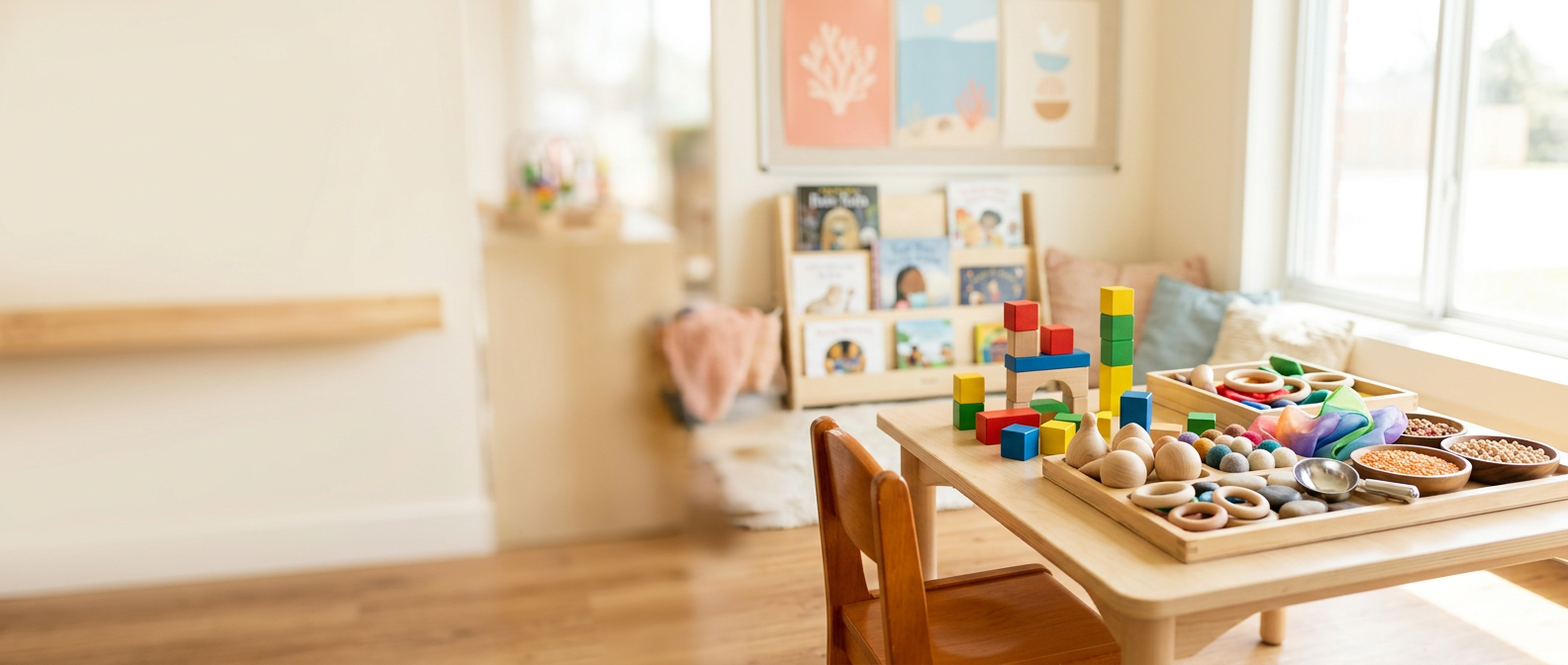
A classroom where every child can participate
Our welcoming learning spaces encourage children to explore, connect, communicate, and try again. Flexible materials, visual supports, calm spaces, and intentional routines help make the day accessible, predictable, and full of possibility.
Create Your Own Website With Webador